
Haven advocate to lawmakers: Big overlap between trafficking, domestic violence
If lawmakers want to support survivors of sex trafficking in Montana, they can start by looking past common stereotypes, a Haven advocate told a Montana legislative panel recently.
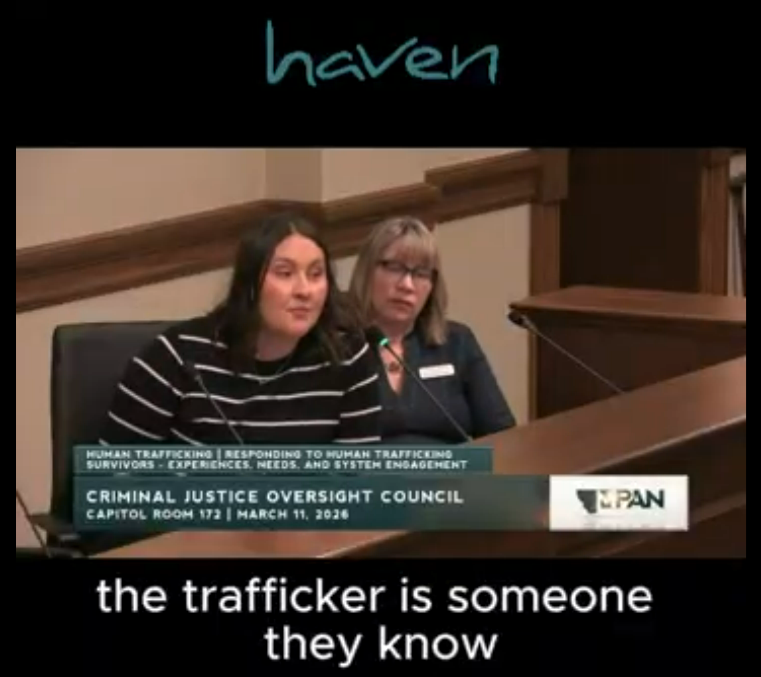
Trafficking happens in Montana, Haven advocate team lead Sha told lawmakers, but it often looks nothing like the version people take from movies or see in headlines. More often, she said, trafficking is intertwined with domestic violence, done by someone the survivor knows, and happening in a home, not across state lines.
“More often than not, they are being trafficked in their own home,” Sha said of trafficking survivors.
She said trafficking and domestic violence are too often treated as separate issues, even though many of the tactics overlap: coercion, intimidation, isolation, emotional abuse, economic abuse and threats.
“We have addressed this issue very separately,” Sha said, “when in reality, it is mostly intertwined.”
Sha offered proof points from her own work with survivors. In one case, a survivor who’d become unhoused after leaving an abusive relationship met their trafficker at a center for unhoused people. In another, a survivor’s abusive partner trafficked them for sex to keep a roof over their heads. In a third example, a survivor returned to a trafficking situation because Haven didn’t have a room available the first time they reached out.
Three of the four survivor examples Sha shared involved abusive relationships.
Sha added that survivors have a lot of needs after they leave a trafficker: shelter, transportation, phones, support with housing, support in navigating the courts, counseling, safety planning, and help meeting their basic needs.
“Leaving is not the final step,” Sha told lawmakers. “In fact, it’s not even close to the end of the finish line.”
The need for support is now bumping up against a shortage of shelter beds and support – even in Gallatin County, which is relatively well-resourced compared to other parts of Montana. Sha said that Haven is often at capacity, and added that last fiscal year, Haven had to deny a bed to a total of 107 survivors.
Sha urged lawmakers to consider improvements, including:
more shelter and transitional housing
more training for judges, attorneys, law enforcement and court staff on what trafficking can look like
stronger funding for advocates
changes to crime victim compensation rules
more room for survivor voices in policy discussions